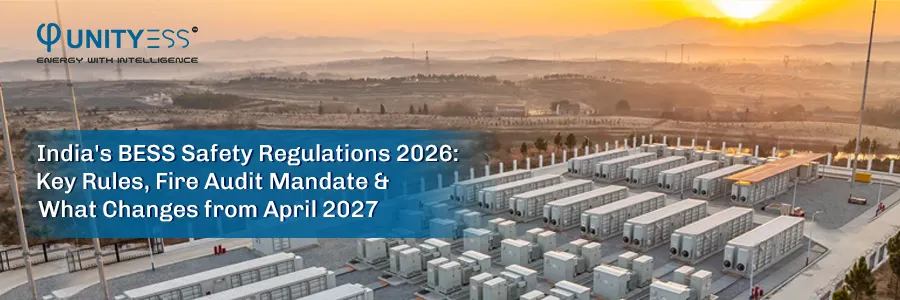
India's BESS Safety Regulations 2026: Key Rules, Fire Audit Mandate & What Changes from April 2027
India has introduced a comprehensive safety framework for Battery Energy Storage Systems (BESS) through the latest amendment issued by the Central Electricity Authority. The regulation was notified on 27 March 2026 in the Gazette of India and will come into force from 1 April 2027.
This amendment inserts a new Chapter XA into the existing Measures relating to Safety and Electric Supply Regulations, 2023, specifically addressing BESS installations. It establishes clear technical and safety requirements covering design, operation, fire protection, and compliance.
Background: Why These Regulations Were Introduced
India's growing renewable energy capacity has increased the need for grid-scale energy storage. As BESS deployments expand, safety risks—particularly those related to thermal runaway, fire hazards, and system failures—have become more critical.
The 2026 amendment addresses this gap by introducing a structured framework that aligns safety requirements with the scale and complexity of modern battery storage systems. It also brings India's regulatory approach closer to globally accepted safety practices.
Applicability and Timeline
The regulation follows a defined timeline and scope:
- Draft issued for public consultation: 20 June 2025
- Final notification: 27 March 2026
- Effective date: 1 April 2027
The provisions under Chapter XA apply to BESS installations connected at voltage levels exceeding 650V. Installations at 650V and below are not covered under the detailed Chapter XA requirements but must comply with applicable standards, as specified under Regulation 122(N).
Need a BESS that meets India's 2026 safety standards?
Talk to Our ExpertsStructure of Chapter XA
Chapter XA introduces Regulations 122(A) to 122(N). These provisions do not replace earlier safety requirements but operate in addition to the existing regulations.
The chapter covers:
- general system design and safety principles
- equipment layout and installation requirements
- hazard detection and suppression systems
- site-level security and emergency measures
- compliance verification through audits
This creates a complete safety framework across the lifecycle of a BESS project.
Two-Fault Tolerance Requirement
A key provision under Regulation 122(B) is the requirement for two-fault tolerance.
This means a BESS must be designed to remain safe—even in the event of two independent faults occurring simultaneously or sequentially. These conditions include:
- overcharge or over-discharge
- short circuit
- operation outside specified temperature limits
This is a design-level requirement and requires redundancy in protection systems across different layers of the BESS architecture.
Battery Management System (BMS) Requirements
The amendment defines specific expectations from the Battery Management System.
The BMS must:
- monitor voltage and temperature at cell and module levels
- detect thermal runaway conditions
- monitor current at the rack level
- trigger audio-visual alarms when limits are exceeded
If operating parameters go beyond OEM-specified limits, the system must automatically stop charging and discharging. This ensures immediate response without manual intervention.
Fire Detection and Suppression
Under Regulation 122(F), fire safety systems are mandatory for all applicable BESS installations.
Each container must include:
- detection systems for smoke, heat, gas, and flame
- an automatic fire suppression system compliant with relevant standards
These systems must also be protected from environmental damage and unauthorised access while remaining accessible for maintenance.
Ventilation, Cooling and Explosion Protection
Thermal and environmental control is addressed through multiple provisions.
BESS installations must include:
- ventilation and HVAC systems designed as per relevant standards
- automatic shutdown in case of ventilation failure
- measures to prevent accumulation of flammable gases
Battery containers must also incorporate explosion protection features, including forced ventilation and controlled airflow systems.
Equipment Layout and Site Safety
The regulation also specifies requirements for installation and site-level safety.
These include:
- minimum spacing between BESS units and nearby structures (based on battery chemistry)
- containment systems for electrolyte spills (where applicable)
- emergency lighting and safety signage
In addition, site security measures such as perimeter fencing (minimum 1.8 metres), surveillance systems, and intrusion detection are mandatory.
Emergency Shutdown and Earthing
BESS installations must be equipped with:
- automatic shutdown mechanisms triggered by safety anomalies
- manual emergency stop systems at accessible locations
All equipment must comply with earthing requirements as per applicable standards, without exception.
Mandatory Third-Party Fire Safety Audit
One of the most important compliance requirements is introduced under Regulation 122(M).
Every BESS installation must undergo an independent third-party fire safety audit within three months from the date of commencement of the regulations (1 April 2027).
The audit report must be submitted to the Electrical Inspector at the time of inspection.
Additionally, the regulation mandates that fire safety authorities be trained for BESS-related risks, with guidelines to be issued by the relevant agencies.
Applicability for Systems ≤650V
Installations operating at 650V or below are covered under Regulation 122(N).
While they are exempt from the detailed provisions of Chapter XA, they must still comply with relevant applicable standards based on their voltage class.
Relevant Standards to Be Issued Separately
The regulation frequently refers to compliance with “relevant standards,” but these are not listed within the amendment itself.
Under Regulation 137, the Central Electricity Authority will issue a separate list of applicable standards within three months of the regulations coming into force, i.e., by approximately July 2027.
Until then, industry practice is expected to align with established IEC and Indian Standards.
Impact on Industry Stakeholders
The amendment introduces clear responsibilities across the value chain.
Developers and EPC companies must incorporate safety requirements at the design stage, particularly for two-fault tolerance and fire protection systems.
OEMs must ensure that their equipment, including PCS and BMS, is compatible with the specific battery chemistry and meets the monitoring and protection requirements defined in the regulation.
Existing BESS installations will also need to comply with the fire audit requirement within the specified timeline, making early assessment and preparation important.
Conclusion
The BESS Safety Regulations 2026 mark a significant step in formalising energy storage safety in India. By introducing structured design requirements, mandatory fire protection systems, and independent safety audits, the regulation establishes a clear compliance framework for the industry.
As BESS deployments continue to grow, these regulations ensure that expansion is supported by robust safety standards, operational reliability, and regulatory clarity.
About UnityESS
UnityESS is a next generation energy storage system in India, developed by Ornate Solar in collaboration with Inverted Energy. Our BESS solutions are engineered to align with India's evolving safety regulations, including the requirements introduced under Chapter XA of the 2026 amendment.
For guidance on compliance, fire safety audits, or selecting a regulation-ready BESS, call us at 1800 2026 252 to discuss your project.